Facing Nadakacheri Certificate Problems? Easy Solutions for Karnataka
Over the past few weeks, I’ve received many emails from users asking for help with Nadakacheri applications. They shared their struggles applications stuck at “pending at VAO/RI,” OTP failures, payment errors, and rejections for certificates like caste, income, family tree, domicile, and OBC. After seeing how common these problems are, I decided to write this guide on Nadakacheri Certificate Problems with practical solutions based on real experiences.
The Nadakacheri (AJSK) portal in Karnataka is meant to make certificate applications simple, but thousands of citizens face delays and hurdles every year. In this guide I have discussed the most common technical and document-related issues and their solutions. Whether you’re facing issues with a a family tree without property or facing payment failures, this post will help you to resolve these issues and get your certificate on time.
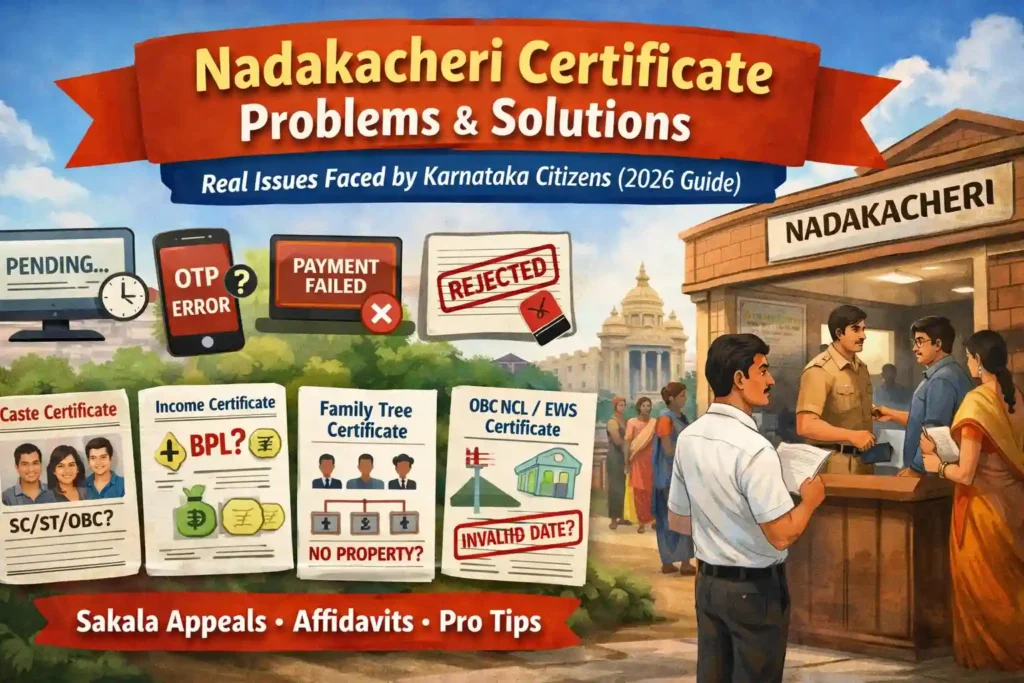
Why Nadakacheri Applications Get Rejected
The AJSK portal (ajsk.karnataka.gov.in) handles thousands of applications, especially during job and admission seasons. Some main reasons for delays or rejections:
Tip: Always use the official link ajsk.karnataka.gov.in. Apply early and track your application daily using the RD/Acknowledgment number.
Technical Portal Issues
Most Nadakacheri Certificate Problems problems occur before verification. Common Nadakacheri 5.0 technical issues are:
| Problem | Why It Happens | Frequency | Solutions & Workarounds |
| e-Sign / Aadhaar OTP Failures | Aadhaar not linked, biometric mismatch, or network issues. | Very High | Use mobile OTP instead of fingerprints. Try incognito mode or a different browser/device. Visit the nearest Nadakacheri center for manual e-sign. |
| Payment Failures | UPI/card errors, session timeout, or bank issues (₹40–₹60 fee). | High | Use net banking, wait 30 minutes, and retry. Take a screenshot. Money is usually refunded if the application fails. |
| File Upload Rejections | PDFs too large (>200–500 KB), wrong format, blurry scans. | Very High | Compress files <200 KB (e.g., ilovepdf.com). Scan in color at 150–200 DPI. Rename files clearly (aadhaar.pdf). |
| Status Not Updating | Portal shows “pending” even after approval. | Medium | Wait 24–48 hours. Check with a mobile app or RD number. Visit center for printout. |
| Biometric Mismatch | Aadhaar photo/fingerprints don’t match offline help. | Medium | Update Aadhaar. Carry voter ID or PAN as backup. |
These issues increased in 2025–2026 because more people applied online. Fixing them early can save weeks.
Document & Verification Problems
Even after submitting your application online, many people face Nadakacheri Certificate problems because of the documents needed for each certificate. Each certificate like caste, income, family tree, or domicile has its own rules. If something is missing or not correct, officials may reject or delay your application. Knowing the common problems and how to fix them makes it much easier to get your certificate without stress.
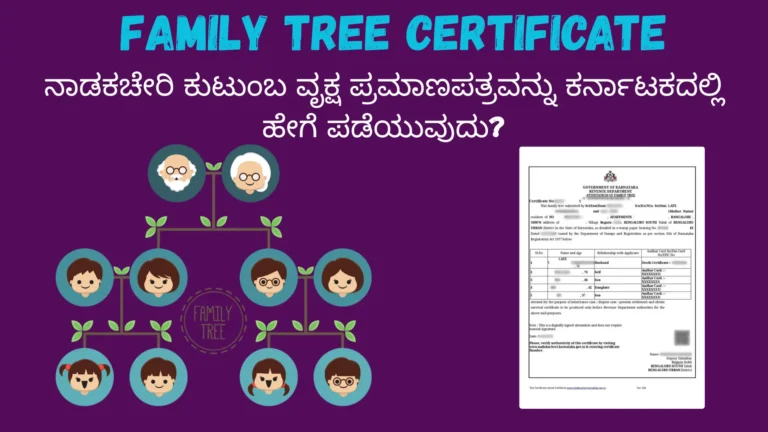
1. Family Tree (Vamsha Vruksha) Certificate
Main Problem: Your application may be rejected if there are no property or land documents. This happens a lot for urban families and people who have moved from other places. Officials usually ask for documents like RTC, property tax receipts, or encumbrance certificates.
Other Nadakacheri Certificate Problems:
Solutions:
2. Caste Certificate (SC/ST/OBC/Cat-1)
Main Problem: Parents or relatives don’t have caste certificates.
First-generation or migrant applicants may get VAO pending or rejected.
Other Nadakacheri Certificate Problems:
Solutions:
3. Income Certificate
Main Problem: Income proof mismatch (ITR/salary higher than declared).
Common when applying for schemes or benefits.
Other Nadakacheri Certificate Problems:
Solutions:
4. OBC-NCL / EWS Certificate
Main Problem: OBC Certificate not valid for current financial year (must be issued after April 1).
Creamy layer disputes common for central jobs/exams.
Solutions:
5. Domicile / Residence Certificate
Main Problem: Proving long-term Karnataka residence (non-natives or renters).
Solutions:
6. Other Common Issues Across Certificates
What to Do if Your Nadakacheri Application is Delayed
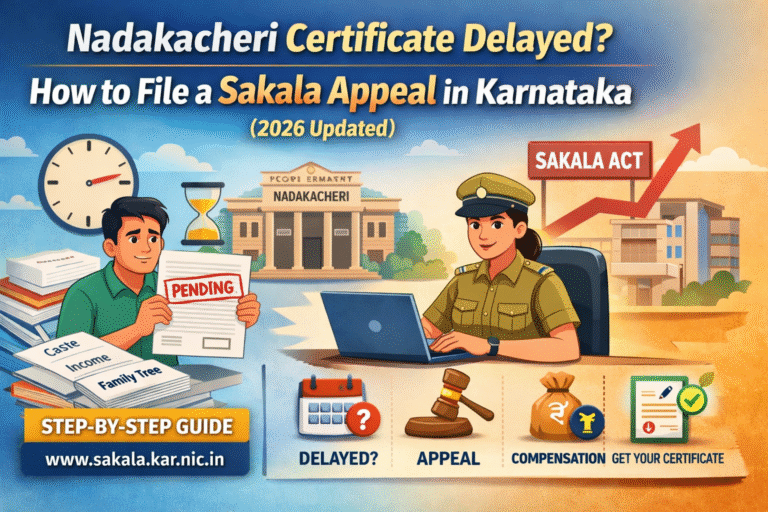
The most common problem is that applications stay stuck at “Pending with VAO/RI” even after the official Sakala timelines. For example, caste certificates can take 21 days, family tree certificates 45 days, and income certificates 30 days, but many people wait much longer.
Solutions:
- Visit your nearest Nadakacheri or Tahsildar office and politely ask about the status of your application.
- File Sakala appeal online (sakala.kar.nic.in) using GSC number most applications resolve in 7–15 days.
- Avoid agents charging ₹1,000–₹5,000. Everything is free online.
Common Issues Reported by Users
| Problem Type | Frequency | Quick Fix |
| Technical (e-Sign/OTP/Payment) | Very High | Retry with different method/browser |
| File Upload Issues | Very High | Compress & rescan documents |
| Delays/Pending at VAO | Very High | Sakala appeal |
| No Property (Family Tree) | High | Affidavit + Voter ID/Ration Card |
| No Parental Caste Proof | High | Grandparents/School Records |
| Income/Creamy Layer Disputes | Medium-High | Latest ITR/Form-16 |
| Status Not Updating | Medium | Wait 48 hours + visit center |
| Migrant/Residence Proof | Medium | School certificates + affidavit |
Conclusion
Technical glitches, strict document rules, or delayed approvals can frustrate anyone applying through Nadakacheri. However, most problems are solvable with the right preparation. Make sure to gather alternative proofs like affidavits, school records, and voter IDs before applying.
Address portal issues early, whether it’s e-sign, OTP, or file upload problems. Avoid paying agents, as filing a Sakala appeal is often enough to resolve delays quickly. By staying organized, patient, and proactive, you can get your caste, income, family tree, or domicile certificate without unnecessary stress and avoid common pitfalls.